|
More About Sea Anemones ...
|
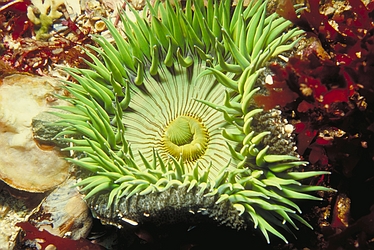
Named after a terrestrial flower, the anemone, the sea anemone is a group of ocean-dwelling, filter feeding animals of the order Actinaria. As a cnidarian, it is closely related to coral and jellyfish. The anemone is a (usually) solitary polyp with stinging cells (cnidocytes) in its tentacles. These stinging cells serve to paralyze and capture prey, which is then moved by the tentacles to the mouth for digestion inside a central cavity.
Other close relations to the sea anemone are the solitary, tube-dwelling anemones and the hydras.
The sea anemone has a foot which attaches itself to rocks or anchors in the sand. Some sea anemones form symbiotic relationships with crabs and anemone fish, also known as clownfish. In the former situation, anemones will either attach or be attached to the shell of a hermit crab (by the crab's own volition), providing additional protection for the crab and allowing the anemone to eat scraps when the crab feeds. A similar relationship can be formed between a sea anemone and a clownfish. The clownfish presses itself into the anemone, living comfortably within the stinging tentacles: This is possible because of a protective slime that covers the clownfish. The clownfish benefits from this symbiotic relationship because it is protected by the anemone and also gets food scraps from it.
Although not plants and therefore incapable of photosynthesis themselves, sea anemones form an important symbiosis with certain single-celled green algae species which reside in the animals' gastrodermal cells. These algae may be either zooxanthellae, zoochlorellae or both. The sea anemone benefits from the products of the algae's photosynthesis, namely oxygen and food in the form of glycerol, glucose and alanine; the algae in turn are assured a reliable exposure to sunlight, which the anemones actively maintain.
|
|
Source: Wikipedia Read more about Sea Anemones
|
|
|
PICTURES (Click to enlarge)
|
 |
 |
 |
| Anthoplura Anemone |
Rose Anemone |
Purple Anemone |
|
 |
 |
 |
| White Spotted Rose Anemone |
Anemone |
Anemone |
|
 |
 |
 |
| Sea Anemone |
Sea Anemone |
Red Sea anemone |
|
 |
|
|
| White Anemone |
Sea Anemone |
Orange And Pink Anemone |
|
|
|
|
| Anemone |
White Sea Anemone |
Boule Brush Anemone |
|
|
|
|
| Red Anemone |
Spiral Anemone |
Pink Sea Anemone |
|
|
|
|
| Pink Spiral Anemone |
Sea Anemone |
Lavender Anemone |
|
|
|
|
| Sea Anemone |
Sea Anemone |
Metridium Anemone |
|
|